hero-bg-pricing

Get your team started in minutes

Sign up with your work email for seamless collaboration.

Best Practices for Cloud Computing Architecture
Technical Diagramming

Best Practices for Cloud Computing Architecture

Author
Cloudairy
By Cloudairy Team
January 10, 2026
10 min read

For many businesses I’ve worked with, the architecture of cloud computing directly defines how teams deliver seamless services, organize important business data, and maintain resilience in complex environments. By embracing practical best practices, modern companies gain realistic strategies for designing scalable systems that reinforce overall reliability, safeguard efficiency, and meet strict compliance requirements. Meanwhile, these adaptable methods naturally align IT operations with evolving organizational business goals, ensuring technology consistently acts as a driver of meaningful growth instead of turning into an unwanted obstacle.

Key Best Practices in Cloud Architecture Design

In real-time IT projects, designing for the cloud always feels very different from working with traditional systems. Applying cloud computing best practices allows architects like me to leverage the cloud’s strengths while carefully avoiding its risks.

  • Layered abstraction – Splitting the architecture of cloud computing into application, data, and infrastructure layers has worked well in my projects. It enforces modularity, which allows straightforward updates, smoother troubleshooting, and efficient scaling, all leading to improved reliability.
  • Resilience engineering – I’ve seen that spreading workloads across regions and availability zones is a must. It prevents systems from failing at a single point and ensures dependable uptime during any sudden outages or disasters.
  • Security by design – For me, IAM controls, encryption, and proactive monitoring must be designed early. Embedding them within cloud architecture design dramatically reduces vulnerabilities and avoids expensive security issues.
  • Automation with IaC – I personally prefer automation tools like Terraform, Ansible, or AWS CloudFormation. They bring consistency to the entire setup, cut down repetitive tasks, and enable quick yet reliable environment provisioning.
  • Continuous monitoring – Monitoring logs, metrics, and performance data in real-time has repeatedly helped my team detect risks early. This proactive step ensures smoother performance optimization and a much better user experience overall.

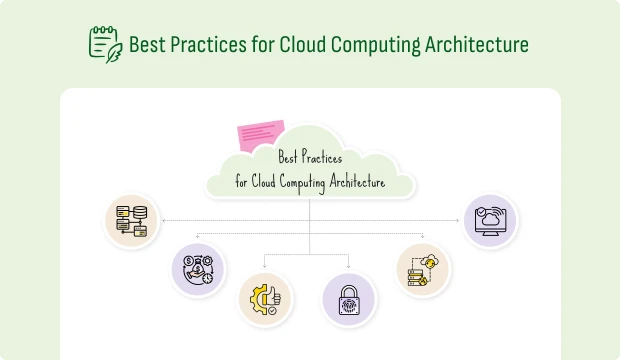
Template: Cloud Computing Architecture Diagram Template.

Cloud Computing Architecture Diagram Template

Industry-Specific Application of Best Practices

Cloud best practices are universal in principle, but different industries usually adapt them carefully based on compliance, performance, and unique customer needs.

  • Healthcare – In healthcare environments, the architecture of cloud computing emphasizes HIPAA compliance, encrypted storage for sensitive patient data, and tightly controlled access policies. Real-time monitoring also helps ensure constant availability of life-critical systems without any unwanted downtime.
  • Finance – Within finance operations, the cloud architecture design strongly focuses on PCI-DSS compliance, rigorous transaction monitoring, and reliable disaster recovery methods to protect customer trust. Cloud-native fraud detection tools are often integrated into cloud architecture designs.
  • Retail – Uses elastic scaling to handle seasonal demand. Cloud caching and CDNs optimize customer experience during traffic surges like Black Friday.
  • Education – Requires affordability and scalability for online courses. Cloud platforms support video streaming, collaboration, and real-time assessments.

Challenges in Applying Cloud Architecture Best Practices

Even with well-established guidelines, many businesses like ours honestly still face challenges when implementing cloud strategies in real-world projects.

  • Complexity of multi-cloud – Adopting multiple providers actually introduces governance issues and ongoing monitoring challenges that our teams often struggle with.. Each cloud has unique IAM and networking models.
  • Cost overruns – Without proper cost management, scaling services quickly leads to unanticipated bills. Best practices encourage automation and monitoring of usage patterns.
  • Evolving compliance – Regulations like GDPR and HIPAA evolve constantly, requiring architectures to adapt rapidly to stay compliant.
  • Skill gaps – Teams often lack the expertise needed to apply best practices consistently. Using visual templates and IaC can help bridge this gap.

Templates and Visuals to Get Started

Conclusion

Applying thoughtful best practices to the architecture of cloud computing in real scenarios ensures organizational systems are scalable, strongly secure, and flexible enough to meet evolving business needs. By steadily following these reliable principles in daily practice, innovative organizations can reduce potential risks, optimize critical costs, and confidently future-proof their ongoing operations.Cloudairy’s Cloud Architecture Diagram Tool makes these practices actionable by providing visual templates that help teams apply proven design strategies consistently

Ready to create smarter with AI?

Start using Cloudairy to design diagrams, documents, and workflows instantly. Harness AI to brainstorm, plan, and build—all in one platform.

Recommended for you
Using Flow Diagrams in Agile Teams
Technical Diagramming